Bring your own TSA: use your own timestamping authority in Sigill
A timestamping authority is an awkward dependency to migrate.
It may already be named in a vendor agreement, approved by security and compliance, or embedded in release and signing workflows. A team can want Sigill's evidence ledger, sealing flow, verification tools, public lookup, and SDKs without wanting a second migration project just to replace the TSA it already trusts.
That is now supported.
Paid tenants can connect their own RFC 3161 timestamping authority to Sigill. The TSA remains private to the organisation, is checked server-side before it can be saved, and is selected explicitly through the same timestamping routes that already handle Sigill-managed standard timestamping.
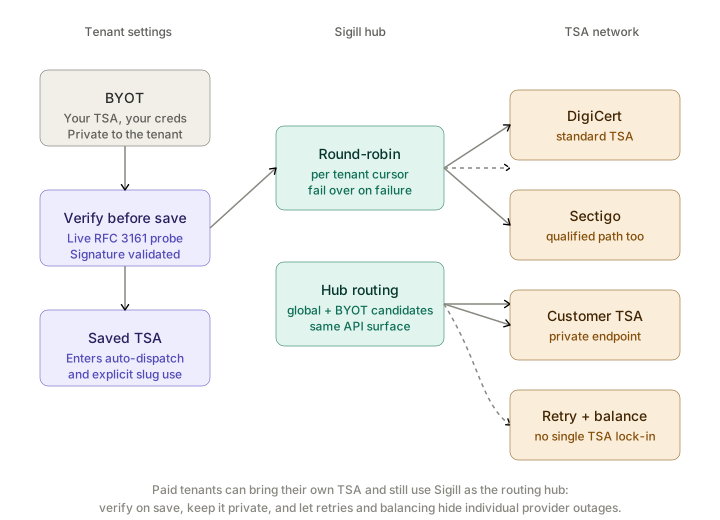
Keep the TSA. Add the evidence layer.
Bring-your-own TSA is useful because it separates two decisions that should not have to be made at the same time:
- Which timestamping authority your organisation trusts.
- Which system records, routes, seals, and verifies the resulting evidence.
If you already have an approved TSA, you can keep it while moving your evidence workflow into Sigill. Timestamp hashes through the provider you chose. Use Sigill for the ledger trail, verification and lookup surfaces, and PAdES or CAdES seal workflows around those proofs.
It is also useful when adoption is not the issue at all. Teams that depend on a single TSA have a single external dependency in the critical path of producing timestamped evidence. Adding another eligible authority gives Sigill somewhere to route a request when a provider is unavailable or slow.
A saved endpoint has already proved it works
Connecting a TSA is not just storing a URL and hoping the first production request succeeds.
Under Settings → Timestamp authorities, an owner enters the endpoint and authentication mode, then runs verification. Sigill performs a live RFC 3161 request, parses the returned timestamp response, and verifies its token signature. A configuration that fails that check cannot be saved.
Credentials stay server-side and are protected at rest. The resulting TSA configuration belongs only to the tenant that created it; it does not appear as a platform provider for other organisations.
That server-side check matters. The platform is accepting a new source of cryptographic evidence into a tenant's workflow. It needs proof that the endpoint can produce a valid timestamp token, not a browser-side green checkmark.
Routing without provider logic in every integration
Sigill treats timestamping as a routed service with two distinct customer-facing options. tsaSlug: "auto" is Sigill-managed standard RFC 3161 timestamping — internally redundant with failover across managed sources, but not customer-selectable at the source level. tsaSlug: "byot:<your-slug>" targets a verified tenant-owned endpoint, kept private to the organisation. Customers choose between the two by what they pass to /tsa/stamp-hash and /tsa/restamp; there is no implicit blending.
This keeps the policy boundary explicit. Code that always wants Sigill-managed standard timestamping keeps using auto. Code that needs a specific customer-owned authority addresses it by its BYOT slug. Either path is one string change away from the other, and nothing changes underneath an integration unless it changes the slug itself.
Seal operations follow the same model. Embedded RFC 3161 timestamps on PAdES and CAdES seals are produced via Sigill-managed standard timestamping; BYOT endpoints are used by addressing them through /tsa/stamp-hash and stitching the resulting proof in your own workflow when you need a customer-managed authority on the timestamp itself.
The SDK path becomes more practical
The same is true for the open-source sigill-python and sigill-dotnet SDKs.
sigill-python and sigill-dotnet already handle the repetitive part of AI evidence workflows: canonicalise an evidence envelope, hash it, send only that hash to Sigill for RFC 3161 timestamping, and attach the resulting proof. With a tenant-owned TSA configured in Sigill, applications using the SDK can keep that integration while the timestamp can come from a provider the organisation already uses.
That is the useful combination: your code uses an SDK instead of custom canonicalisation and timestamp glue; your organisation can retain its approved TSA; and Sigill provides the routed evidence layer between them.
The SDK envelope format remains open, and verification remains based on the proof itself. BYOT does not turn a private provider into a proprietary requirement.
What BYOT does not claim
A tenant-owned TSA is not made qualified merely by adding it to Sigill. Sigill verifies that it responds correctly and that the returned token signature is valid; it does not replace the customer's responsibility for choosing the authority, contractual trust, policy qualification, or regulatory assessment.
Nor does a tenant-owned TSA appear in any cross-tenant discovery surface. It is scoped to the organisation that configured it.
Those boundaries are deliberate. Bring-your-own TSA is a way to use Sigill without giving up an existing trust decision, not a way to blur who made that decision.
Available now
Bring-your-own TSA is available for paid tenants under Settings → Timestamp authorities.
For teams already operating with a trusted RFC 3161 provider, this removes a practical blocker: you can adopt Sigill's ledger, routing, verification, sealing flows, and SDK-based evidence workflows without replacing your timestamping authority first.